Monday, 29 December 2014

Get your Health & Safety in order


As a new calendar year approaches, it's time to get your Health & Safety in order. All businesses, companies and organisations will benefit from having a simple yet robust system in place to assess, control and monitor their health and safety issues. If you employ 5 or more people (employ does not necessarily mean pay, volunteers count as employed) then you are legally bound to produce a written health and safety policy, with the necessary procedures in place to make it happen, that said there is no reason why you shouldn't have the same even if you employ less than 5 people.

If you own or operate premises then you must carry out a fire risk assessment of those premises, again if you employ 5 or more people then this assessment must be formally written. A fire risk assessment will drive out any necessary actions to make the premises in which you work, safe from fire. This will include housekeeping, training and maintenance items such as servicing of extinguishers and testing of electrical appliances.

In both cases above, it is essential that once produced these documents are reviewed whenever there are any changes, which affect either the building or your work practices, or at least annually.

It may be that you already have procedures in place that might benefit from being given a review by a third party, or you might like to have an independent eye check that your systems are being operated correctly, either way now is the time to make sure that your health and safety is given the attention it needs to ensure that everyone you are responsible for, is kept safe.

For more information or advice please contact us via www.anchorhands.co.uk

Thursday, 5 June 2014

Fire Safety Is Your Business


Some years after changes to fire safety law, The Fire Brigade is warning that many businesses still don’t have enough understanding of how the law affects their business or premises, and could be risking financial ruin or even prosecution.

The Regulatory Reform (Fire Safety) Order came into affect in October 2006 and replaced over 70 separate pieces of fire safety legislation. The Order applies to virtually all buildings, places and structures (the main exception being private homes) so includes premises like shops, restaurants, offices, nightclubs, care homes, sports venues and also communal areas, parts of blocks and houses of multiple occupation (HMOs) used in common by the occupants of more than one flat or bedsit.

The law places the responsibility for fire safety in the hands of employers and other people who have control of premises such as landlords, owners and other people with control of premises, so having an understanding of fire safety and the role you have to play is at the heart of good business management. This understanding is particularly important for small and medium size businesses and landlords who might not consider fire safety to be a top priority. Research from Touche Ross and London Chamber of Commerce estimates that up to 80 per cent of businesses fail within 12 months of suffering a major catastrophe, such as a fire.

The biggest change under the legislation is that fire risk assessment and a duty of fire safety care was introduced for most premises and replaced fire certificates for those premises that previously required them (factories, offices, shops, railway premises, hotels and larger boarding houses). If you are an employer or have control over a premises (known as the ‘responsible person’) then you are required by law to carry out a fire risk assessment and act on its findings.

The document should assess the fire risks to the property and people that work, live in or visit the premises. The risk assessment should also identify actions which need to be taken in order to protect the building from fire. It must be kept under consent review and amended if any changes are made to the premises.

The Fire Brigade carries out many fire inspections of premises each year and although the majority of buildings are managed well in regard to fire, there are still too many buildings that do not have an adequate fire risk assessment and as a result have fire exits blocked, inadequate fire alarms or poor training for staff. The Brigade can and does prosecute companies or individuals if there are breeches to fire legislation and though court action is a last resort, recent cases show that the courts will issue fines or even consider prison sentences for serious cases.

Tuesday, 14 January 2014

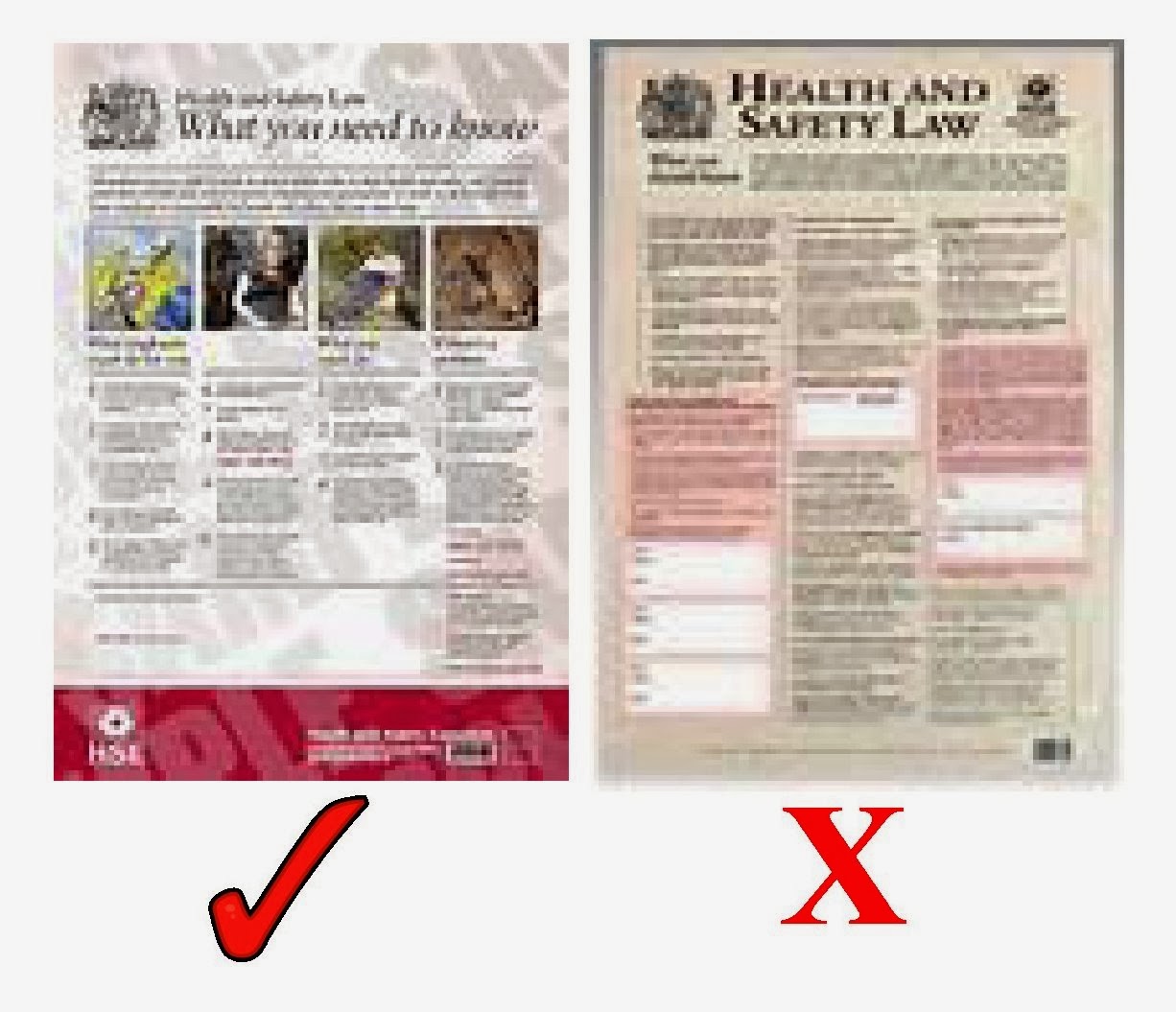
Health & Safety at Work Poster

Please don't forget that as from April 2014 all businesses must display the new version of the Health & Safety at Work poster.

We have noticed that there are still a lot of businesses with the old one on display, so to help you decide whether or not you have the right one, please look at the image below, the one on the left is the new one and the one on the right is the old one.

The new poster has been in existence for some time now and the HSE has always had the April 2014 date in mind for the final exchange, so don't expect a sympathetic ear if you're caught out with the wrong one.

Friday, 27 September 2013

Remember, remember the 5th November, but don’t forget to be safe!


Firework displays should be enjoyable and spectacular occasions – but they obviously need some responsible planning. The good news is that there is straightforward guidance to help you.
If you are organising a major public event, you will clearly need a robust and detailed approach to planning as well as professional involvement. If you are holding a local firework display, such as those organised by many sports clubs, schools or parish councils, you still need to plan responsibly, but the same level of detail is not necessary or expected. Below are some tips and guidance to help you.

Before the event:
  • Think about who will operate the display. There is no reason why you should not light a display yourselves provided it only contains fireworks in categories 1, 2 and 3. but remember, category 4 fireworks may only be used by professional firework display operators. In untrained hands they can be lethal.
  • Consider whether the site is suitable and large enough for your display, including a bonfire if you are having one. Is there space for the fireworks to land well away from spectators? Remember to check in daylight for overhead power lines and other obstructions. What is the direction of the prevailing wind? What would happen if it changed?
  • Think about what you would do if things go wrong. Make sure there is someone who will be responsible for calling the emergency services
  • Make sure you obtain the fireworks from a reputable supplier.
  • If the display is to be provided by a professional firework display operator make sure that you are clear on who does what especially in the event of an emergency
  • Ensure you have a suitable place to store the fireworks. Your firework supplier or local authority should be able to advise
  • If you plan on selling alcohol the bar should be well away from the display site
On the day of the event:
  • Recheck the site, weather conditions and wind direction
  • Don't let anyone into the zone where the fireworks will fall – or let anyone other than the display operator or firing team into the firing zone or the safety zone around it
  • Discourage spectators from bringing drink onto the site
  • Don't let spectators bring their own fireworks onto the site
  • If you will also have a bonfire at the display then you should:
    • Check the structure is sound and does not have small children or animals inside it before lighting it
    • Not use petrol or paraffin to light the fire
    • Have only one person responsible for lighting the fire. That person, and any helpers, should wear suitable clothing e.g. a substantial outer garment made of wool or other low-flammable material.
    • Make sure that the person lighting the fire and any helpers know what to do in the event of a burn injury or clothing catching fire
  • Never attempt to relight fireworks. Keep well clear of fireworks that have failed to go off

The morning after:

  • Carefully check and clear the site. Dispose of fireworks safely. They should never be burnt in a confined space (eg a boiler)

Additional points to consider if you are organising a major public display

For major displays, particularly those involving category 4 ‘professional’ fireworks or very large number of spectators, a more robust approach is obviously needed.
  • Plan and mark out the areas for spectators, firing fireworks (and a safety zone around it) as well as an area where the fireworks will fall
  • Think about how people will get into and out of the site. Keep pedestrian and vehicle routes apart if possible. Mark exit routes clearly and ensure they are well lit. Ensure emergency vehicles can get access to the site
  • Appoint enough stewards/marshals. Make sure they understand what they are to do on the night and what they should do in the event of an emergency
  • Contact the emergency services and local authority. If your site is near an airport you may need to contact them
  • Signpost the first aid facilities

Insurance

Although it is not required by health and safety law, if you are holding a public firework display, it’s a good idea to have public liability insurance. Bear in mind that not all companies are used to dealing with this type of event, and as with any other type of insurance, it’s worth shopping around: look for a company that’s used to insuring firework and other public events – you are likely to get much better deal and avoid unsuitable terms and conditions. If you have difficulty with the standard insurance terms, TALK to your insurer and find a way forward; they can be very helpful.

Wednesday, 10 April 2013

No Frills Networking. Expo 2013

Watch out for the No Frills Networking Expo 2013, to be held at the Bonded Warehouse, Stourbridge on Saturday 22nd June from 09:00 until 13:00. Full details below:


Wednesday, 2 January 2013

Who is responsible for fire safety?


Who is responsible for fire safety?
Generally, the employer (Responsible Person) is responsible for the fire safety of all who are lawfully on the premises (Relevant Persons). These include employees, visitors, contractors, members of the public and any person in the immediate vicinity, such as people walking past. Operational fire fighters at incidents are not included.
Responsibility for managing duties on behalf of the Responsible Person (RP) at the head of an organisation may be shared, for example, between branch or area manager, depending on the extent of control each has i.e. they must have the appropriate authority, skills and training to manage these duties. 
Is it permissible for others to carry out duties on behalf of the Responsible Persons?
Yes, the RP may nominate Competent Persons (CP). For instance, an RP may nominate others to act as fire marshals or wardens with a duty for assisting with evacuation; or an engineer might be given the task of testing fire alarms.
The RP must ensure CPs have the ability to carry out their tasks i.e. they must be properly competent, trained and equipped, or external experts may be brought in to fill any shortfall. 
Please bear in mind that delegating duties falling within the RP’s remit does not absolve a person from responsibility. It is down to the RP to put sufficient checks in place to ensure delegated duties are carried out correctly.
Do employees have responsibility?
Yes, employees must take reasonable care for the safety of themselves and others who may be affected by their acts or omissions at work e.g. wedging open a fire door. It is the RP’s responsibility to ensure employees receive training.
Who is responsible for fire safety in multi-occupied premises?
This may be shared by several people. In a multi-occupied office, the landlord/owner and tenants may be responsible for common areas with each occupier responsible for the areas they control. 
The fire alarm may be the sole responsibility of the landlord/owner if it is common to the entire premises. A tenancy agreement should identify who is responsible for each area of fire safety.
Occupiers have a duty to take reasonable steps to co-operate and co-ordinate with each other.
Who is responsible for fire safety when there is no employer?
The person in control of the premises is responsible. This could be the person or organisation paying the rent or owning the building. e.g. a charity trustee in the case of a charity shop or a parish council in case of a village hall.
Who is responsible for fire safety in an unoccupied building?
This is normally the owner of the building
For more information or help in carrying out a Fire Risk Assessment see our website www.anchorhands.co.uk

Monday, 22 October 2012

Fee For Intervention is Here


This month saw a new system for health and safety inspections come into force in the UK, which will result in companies being billed for some regulatory activity.

Under the cost recovery scheme, unveiled by the Government earlier this year, businesses failing to comply with legislation could now face heavy costs.

The Fees for Intervention (FFI) initiative is being operated by national regulator the Health and Safety Executive (HSE), which will see charges introduced in a range of areas, including the production of letters and reports, evidence gathering and site visits.

They will be targeted at those organizations that break the rules and will be linked to related costs of taking enforcement action, with an hourly FFI rate of £124 set for 2012-13.

Firms that fully comply with all UK health and safety legislation will continue to incur no charges and the HSE will examine how the system is working after 12 months of operation, reporting the results of its review within three months of the scheme taking effect.

The FFI charges will be in addition to any fines and legal costs faced by businesses charged with failing to meet their health and safety obligations.


If you need help with getting your health and safety system right, then contact us via www.anchorhands.co.uk