Showing posts with label H and S management systems. Show all posts

Monday, 31 December 2018

Health & Safety Management: Why we bother!


When someone uses the phrase “management system” it conjures up an image of an office full of clerks, busy filling in endless reams of paper, without anyone actually knowing what the end result is. This does not need to be the way, especially when it comes to health and safety, the object of the exercise is to have a system that works for your needs, one that not only gives you results but also achieves its objectives of keeping you and everyone else safe.

A health and safety management system can be as simple as a one page set of tick boxes, to make sure you haven’t forgotten something important, right up to an ISO 45001 system which not only controls everything you do with health and safety, but can be audited to an international standard as well as demonstrating that you are working to best practice. The important thing is that the system should do what you want or need it to do, it should not create procedures for the sake of it and should be clear in its results and observations.

Given that a health and safety management system can be simple, certainly shouldn’t be excessive and will produce clear results, what will we gain from having one and how much is it going to cost? There are some very simple answers to these questions:

What will we gain?

A safer working environment
Less absenteeism
Increased production                                    
Happier workforce
Customer recognition                                     
Peer recognition
Mitigation against legal costs                          
Defense against legislation breeches
Lower insurance costs                                    
Access to additional work opportunities         
           
How much will it cost?

Debit:    Producing the system                                     
             Necessary capital expenditure (guarding etc)
             Training costs of personnel                             
             Monitoring & auditing

Credit:   Less absenteeism                                          
             Increased production
             Lower legal costs                                            
             Lower insurance costs
             Mitigation against fines and claims                  
             Maintenance of company reputation
             Increased tendering opportunity

Taking all of the above, together with many more benefits, it can be seen that the reasons we bother are simple, a well produced health and safety management system will help you keep all around you safe thus avoiding absenteeism, lost production and legal claims against you, it will help you comply with current legislation avoiding legal costs, it will demonstrate to customers and your peers, that you are a company they would like to do business with, it can help keep your insurance costs down, maybe even reducing them and it could provide the conditions that will allow you to access many other tendering opportunities.

So, why bother?                        Increased profitability
                                                Increased reputation and profile
                                                Happier, more productive workforce
                                                Increased work opportunities
                                                Legal compliance
                                                Because it’s the right thing to do!

If you would like to know more about how effective a health and safety management system can be or to discuss any other matters relating to health and safety, then please contact us at info@anchorhands.co.uk

Thursday, 1 November 2018

Control Of Substances Hazardous to Health COSHH – Why?


If you run a small business or are self-employed, you need this information to make sure you are protecting your employees. If you run a medium-sized or large business, where decisions about controlling hazardous substances are more complex, you may also need professional advice..

Every year, thousands of workers are made ill by hazardous substances, contracting lung disease such as asthma, cancer and skin disease such as dermatitis. These diseases cost many millions of pounds each year to industry, to

§  replace the trained worker;

§  society, in disability allowances and medicines; and

§  individuals, who may lose their jobs.
You, as the employer, are responsible for taking effective measures to control exposure and protect health. These measures can also improve production or cut waste.

Your aim in running your business is to make a profit. You know what you do, and how you are doing it. You know what ‘processes’ and ‘tasks’ are involved. You know the short cuts. Ensuring your workers remain healthy may also lead to healthy profits.

Which substances are harmful?


§  Dusty or fume-laden air can cause lung diseases, e.g. in welders, quarry workers or woodworkers.

§  Metalworking fluids can grow bacteria and fungi which cause dermatitis and asthma.

§  Flowers, bulbs, fruit and vegetables can cause dermatitis.

§  Wet working, e.g. catering and cleaning, can cause dermatitis.

§  Benzene in crude oil can cause leukemia.

Many other products or substances used at work can be harmful, such as paint, ink, glue, lubricant, detergent and beauty products. Ill health caused by these substances used at work is preventable. Many substances can harm health but, used properly, they almost never do.

Find out the dangers in your business – ask your supplier, your trade association.

Substances can also have dangerous properties. They may be flammable, for example solvent-based products may give off flammable vapour. Clouds of dust from everyday materials, such as wood dust or flour, can explode if ignited.

Look at each substance

Which substances are involved? In what way are they harmful? You can find out by:

§  checking information that came with the product, e.g. a safety data sheet;

§  asking the supplier, sales representative and your trade association;

§  looking in the trade press for health and safety information;

 Think about the task

If the substance is harmful, how might workers be exposed?

§  Breathing in gases, fumes, mist or dust?

§  Contact with the skin?

§  Swallowing?

§  Contact with the eyes?

§  Skin puncture?
 
Bear these in mind when you look at the tasks.

Exposure by breathing in
Once breathed in, some substances can attack the nose, throat or lungs while others get into the body through the lungs and harm other parts of the body, e.g. the liver.

Exposure by skin contact
Some substances damage skin, while others pass through it and damage other parts of the body. Skin gets contaminated:

·         by direct contact with the substance, e.g. if you touch it or dip your hands in it;

·         by splashing;

·         by substances landing on the skin, e.g. airborne dust;

·         by contact with contaminated surfaces – this includes contact with contamination inside protective gloves.
 
Exposure by swallowing
People transfer chemicals from their hands to their mouths by eating, smoking etc. without washing first.

Exposure to the eyes
Some vapours, gases and dusts are irritating to eyes. Caustic fluid splashes can damage eyesight permanently.

Exposure by skin puncture
Risks from skin puncture such as butchery or needlestick injuries are rare, but can involve infections or very harmful substances, e.g. drugs.

Friday, 18 May 2018

Noise at work: A brief guide to controlling the risks


The Control of Noise at Work Regulations 2005 (Noise Regulations 2005) require employers to prevent or reduce risks to health and safety from exposure to noise at work. The Regulations require you as an employer to:

Assess the risks to your employees from noise at work; 
Act to reduce the noise exposure that produces those risks;
Provide your employees with hearing protection if you cannot reduce the noise exposure enough by using other methods;
Make sure the legal limits on noise exposure are not exceeded;
Provide your employees with information, instruction and training. Carry out health surveillance where there is a risk to health 


The aim of the risk assessment is to help you decide what you need to do to ensure the health and safety of your employees who are exposed to noise. Your risk assessment should:


Identify where there may be a risk from noise and who is likely to be affected;
Contain a reliable estimate of your employees' exposures, and compare the exposure with the exposure action values and limit values;
Identify what you need to do to comply with the law, e.g. whether noise-control measures or hearing protection are needed, and, if so, where and what type; and
Identify any employees who need to be provided with health surveillance and whether any are at risk


Wherever there is noise at work you should be looking for alternative processes, equipment and/or working methods which would make the work quieter or mean people are exposed for shorter times. You should also be keeping up with what is good practice or the standard for noise control within your industry.

Where there are reasonably practicable things you can do to reduce risks from noise, that are reasonably practicable, they should be done. However, where noise exposures are below the lower exposure action values, risks are low and so you would only be expected to take actions that are relatively inexpensive and simple to carry out.

Where your assessment shows that your employees are likely to be exposed at or above the upper exposure action values, you must put in place a planned programme of noise control


You are required to issue hearing protection to employees:


Where extra protection is needed above what has been achieved using noise control;
As a short-term measure while other methods of controlling noise are being developed.
Provide your employees with hearing protectors if they ask for it and their noise exposure is between the lower and upper exposure action values;
Provide your employees with hearing protectors and make sure they use them properly when their noise exposure exceeds the upper exposure action values;
Identify hearing protection zones, i.e. areas where the use of hearing protection is compulsory, and mark them with signs if possible;
Provide your employees with training and information on how to use and care for the hearing protectors;
ensure that the hearing protectors are properly used and maintained.


  The Noise Regulations require you to take specific action at certain action values. The values are: 

lower exposure action values:
  • daily or weekly exposure of 80 dB;
  • peak sound pressure of 135 dB;
upper exposure action values:
  • daily or weekly exposure of 85 dB;
  • peak sound pressure of 137 dB 

There are also levels of noise exposure which must not be exceeded. These are called exposure limit values: 
  •  daily or weekly exposure of 87 dB;
  •  peak sound pressure of 140 dB.
It is important that employees understand the risks they may be exposed to. Where they are exposed above the lower exposure action values you should at least tell them:


The likely noise exposure and the risk to hearing this noise creates;
What you are doing to control risks and exposures;
Where and how people can obtain hearing protection;
How to report defects in hearing protection and noise-control equipment
What their duties are under the Noise Regulations 2005;
What they should do to minimise the risk, such as the proper way to use hearing protection, how to look after it, store it and where to use it;
Your health surveillance systems.

Health surveillance for hearing damage usually means:


Regular hearing checks in controlled conditions;
Telling employees about the results of their hearing checks;
Keeping health records;
Ensuring employees are examined by a doctor where hearing damage is identified.

Thursday, 19 January 2017

Health & Safety is everyone’s business


There are certain functions within Health & Safety that apply to all personnel, whether they are in the office, on the road or on site. Although the communication and delivery of these functions may differ, dependent upon the location, it is important that everyone recognises them and complies fully with their requirements

There is a legal duty for everyone to take reasonable care for health and safety to themselves and others (this means everyone, staff, public other contractors) as well as not to interfere with or misuse any equipment provide for Health & Safety. In other words, don’t put yourselves or others in danger and use health and safety equipment the way it is designed to be used.

It is important that someone knows where you are, this is so that in an emergency it can be verified very quickly that you are safe, or that you are indeed in imminent danger. To this end, you must comply with the signing in and out procedures laid down at whatever location you may be. When you are in someone else’s premises or on site you must comply with their procedures, make sure you know what they are!

There will be procedures laid down for actions necessary in the event of a fire, when you are on someone else’s property make sure that you have read their procedures and act on them accordingly.

The company will have carried out risk assessments to identify, where possible, any risks that may cause harm, it is important that where applicable these risk assessments are complied with fully. It is a duty of all employees to look after any equipment, tools or furniture in their care, to inspect all equipment for damage and report, without delay, any faults identified. The risk assessments carried out will not be exhaustive, it is therefore a requirement that anyone who identifies a new risk, reports the same back to the company for inclusion within the existing risk assessments.

It is important for everyone to report all accidents, incidents or near misses, no matter how minor, to the appropriate persons. In the event of a serious injury or dangerous occurrence, the company will then decide whether it is necessary to advise the Health and Safety Executive (HSE) or not.

It is everyone’s responsibility to identify new risks or hazards. If you come across a health and safety issue that has not been addressed, then you must notify the company as soon as possible, where appropriate assessments should be carried out, and any necessary procedures or actions put into place.

Remember that everyone is responsible for the health and safety of not only themselves, but that of others!

Tuesday, 17 May 2016

Risk in your business


Here we will be looking at the physical risks that need to be accounted for within any business planning, but hopefully will cover the general areas necessary to give you an idea of what to look out for.
Before we move on let’s be clear what we are talking about.
       
What is Risk?                                           
“Risk is the likelihood of a body or event to cause harm.”
This should not be  confused with Hazard.         

What is Hazard?            
“Hazard is the ability of a body or event to cause harm.”
From this we can see that in order to reduce the risks to our businesses we need to remove, reduce or protect against the hazards we come across. The way we do this is by carrying out a Risk Assessment

There are five steps to carrying out any risk assessment.

Step 1: Identify and record the hazards that are present, these fall broadly into five categories
Physical: such as pressure, heat, damp, noise, radiation and electricity
Chemical: such as dusts, fumes, chemicals, toxic materials and gases
Biological: such as infections, viruses and contagions
Ergonomic: work conditions, stress, RSI and man-machine interaction
The fifth one we'll come back to as it’s covered under specific legislation

Step 2: Identify the people that may be affected by the hazard
Paying particular attention to those groups that may be especially vulnerable such as the elderly, blind, young and disabled.
At this point it is possible to rank the severity of the risk, giving it a more tangible identity

Step 3: Remove, reduce the severity or Protect against, the Hazard.
The preference here is always to remove the hazard completely (rearrange items to avoid trips and impacts), if this cannot be done then reduce the severity of the hazard (use low voltage equipment or less aggressive chemicals) and as a last resort protect against the hazard (provide warnings or personal protective equipment).
Once again assuming that all the measures have been put into place, it will be possible to rank the severity of the residual risks. You can then establish whether the remaining risks are acceptable or if they need further action.

Step 4: Record, Plan, Inform and Train            
Record the significant findings from steps 1 to 3 and what actions have or need to be taken as a result.
Prepare any plans or procedures that may be required in order to facilitate the actions
Inform and instruct all relevant people, co-operate with all concerned.
Provide any necessary training that may be required as a result of the assessment.

Step 5: Review
Having carried out the assessments they must be kept relevant, which means that they should be reviewed on a regular basis or when conditions change (such as work practices, new technology, legislation or results of monitoring)
Remember any revisions to the assessments must be communicated to those that need to know the results of those revisions.
  
Why have we gone to the trouble of doing these risk assessments and putting whatever precautions in place, is it because of our genuine concern for our fellow workers safety, is it because it makes financial sense to do it or is it our legal duty?

The answer is all of the above!

a.     From a humanitarian and moral point of view, we do not want to cause or allow to be caused, harm to anybody
b.    Research shows that investing in risk reduction leads to better company performance.
c.     A good working environment is good business.
d.    Staff feel that they are valued.
e.    Your customers see a company that does it right and cares.
f.      You avoid costs associated with disruption, sickness, investigation, down time, compensation claims, increased insurance premiums and loss of goodwill
g.    And for those companies that cannot see the benefit, there are legal requirements, with quite hefty penalties for non compliance

Remember under step 1 of the risk assessment I said there was a fifth hazard, which was covered under its own legislation, this is Fire!

Potentially this one can be the most destructive, obviously to your staff, the public and visitors, but also to a business.

If your stock and premises are all destroyed, how are you going to trade?

This is why in March 2006 the “Regulatory Reform (Fire Safety) Order 2005” came into force, making it the responsibility of all owners or occupiers of commercial properties, to carry out a Fire Risk Assessment of those premises and put into action any necessary precautions and planning.

For the purpose of the legislation “Commercial” means anything non-domestic, so that includes churches, schools, libraries etc. In fact only military and some government buildings are exempt.

When we carry out our Fire Risk Assessment it’s worth remembering how fire works, for this we use the fire triangle.

 Fire needs 3 elements to exist firstly Fuel (flammable gases, flammable liquids or flammable solids. Secondly Oxygen (The air around us, oxidizing agents and stored oxygen) and finally Ignition (Naked flame, faulty electrical appliances, hot processes and hot machinery)… Remove any one of these and the fire goes out.

We have seen that there are many types of hazards and therefore risks, surrounding our businesses, it is essential then that we Eliminate these risks, if we cannot do this, then we should Reduce the effect of them, and finally Protect against any residual risk.

Remember none of this will work if we do not communicate your findings and plans to those who may be affected.

This way our businesses should be safe environments in which to work, be protected from the disruption and costs that incidents can bring and demonstrate to others that we are responsible and considerate business people.
All of this has to be a cost effective  benefit to all of our businesses, a benefit which you can take to the bank!

If you would like more information, then please contact us at info@anchorhands.co.uk

Monday, 25 April 2016

Statistics show that problems associated with alcohol & drug use is increasing


Many drugs including alcohol can seriously affect your ability to work safely a long time after consumption. 

The immediate effect of drugs can last for anything from 10 minutes to 24 hours. However they can be detected for anything up to 30 days. 

Do not get drunk the night before and expect to work safely the next day. Alcohol takes time to work out of your system (1 pint will take approximately 2 to 3 hours) 

50% of all drivers killed are over the legal limit. Don’t drink and drive 

35% of all fatal accidents are related to alcohol 

You are far more likely to have an accident on site when under the influence of alcohol or drugs. People with drink or drug problems are four times more likely to have accidents at work. 

Everyone has a responsibility to act if they become aware that drugs or alcohol are affecting safety at work of themselves or others. If you know somebody is under the influence of drugs or alcohol, tell your manager or supervisor.

 There are many over the counter and prescribed medications that can affect your ability to work safely, including cold and allergy medications and many painkillers. If you are taking medication, tell your manager.

Thursday, 24 September 2015

Self Employed and Health & Safety

 Image result for self employed

In 2011, the Lofstedt Review  recommended that those self-employed whose work activities pose no potential risk of harm to others should be exempt from health and safety law. This recommendation was accepted by Government.

So, from 1 October 2015, if you are self-employed and your work activity poses no potential risk to the health and safety of other workers or members of the public, then health and safety law will not apply to you.

It is estimated that health and safety law will no longer apply to 1.7 million self-employed people like novelists, journalists, graphic designers, accountants, confectioners, financial advisors and online traders. (source HSE)

If you are still not sure whether this applies to you then contact us and we'll try to help you.

Monday, 29 December 2014

Get your Health & Safety in order


As a new calendar year approaches, it's time to get your Health & Safety in order. All businesses, companies and organisations will benefit from having a simple yet robust system in place to assess, control and monitor their health and safety issues. If you employ 5 or more people (employ does not necessarily mean pay, volunteers count as employed) then you are legally bound to produce a written health and safety policy, with the necessary procedures in place to make it happen, that said there is no reason why you shouldn't have the same even if you employ less than 5 people.

If you own or operate premises then you must carry out a fire risk assessment of those premises, again if you employ 5 or more people then this assessment must be formally written. A fire risk assessment will drive out any necessary actions to make the premises in which you work, safe from fire. This will include housekeeping, training and maintenance items such as servicing of extinguishers and testing of electrical appliances.

In both cases above, it is essential that once produced these documents are reviewed whenever there are any changes, which affect either the building or your work practices, or at least annually.

It may be that you already have procedures in place that might benefit from being given a review by a third party, or you might like to have an independent eye check that your systems are being operated correctly, either way now is the time to make sure that your health and safety is given the attention it needs to ensure that everyone you are responsible for, is kept safe.

For more information or advice please contact us via www.anchorhands.co.uk

Tuesday, 14 January 2014

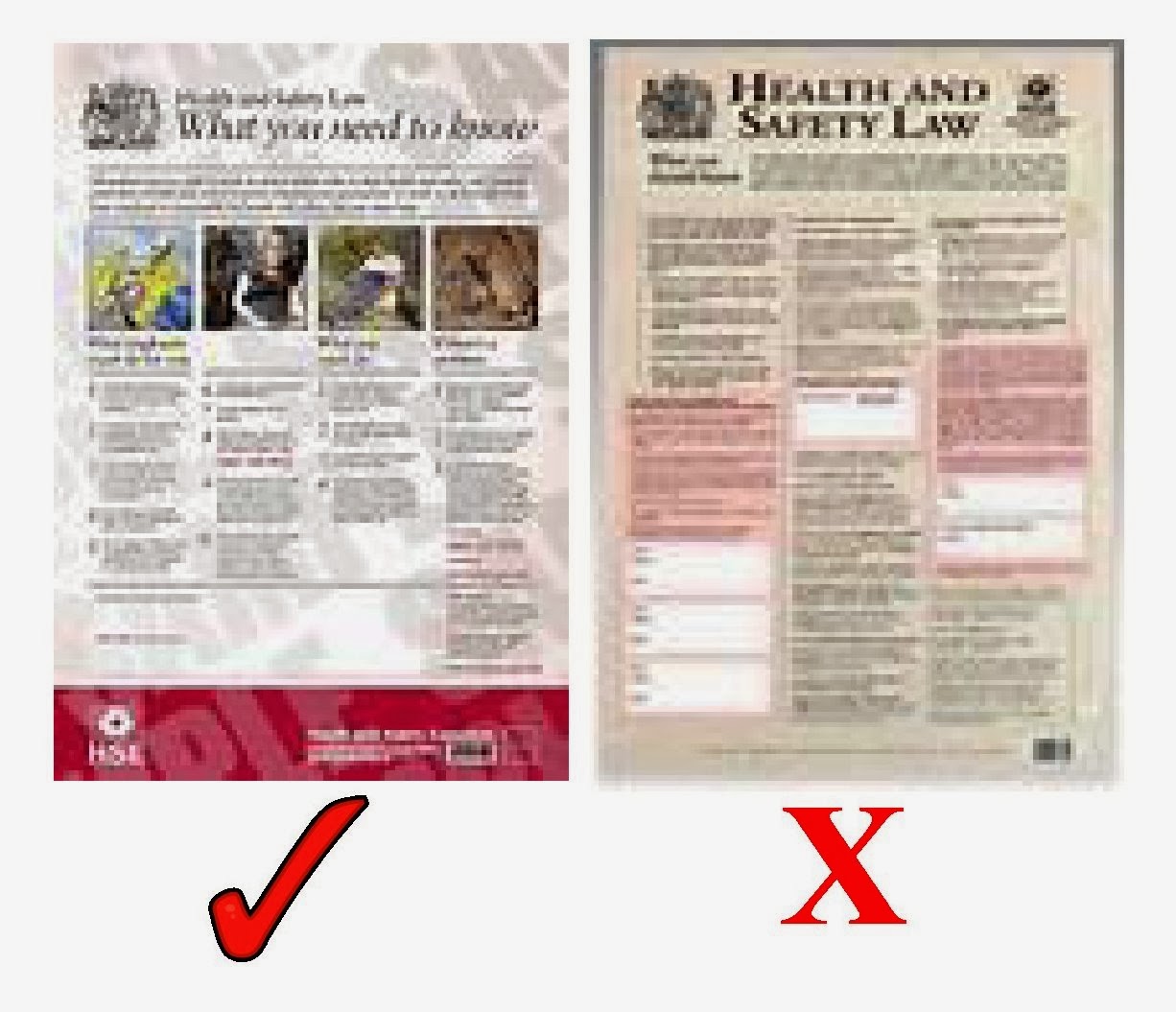
Health & Safety at Work Poster

Please don't forget that as from April 2014 all businesses must display the new version of the Health & Safety at Work poster.

We have noticed that there are still a lot of businesses with the old one on display, so to help you decide whether or not you have the right one, please look at the image below, the one on the left is the new one and the one on the right is the old one.

The new poster has been in existence for some time now and the HSE has always had the April 2014 date in mind for the final exchange, so don't expect a sympathetic ear if you're caught out with the wrong one.

Monday, 22 October 2012

Fee For Intervention is Here


This month saw a new system for health and safety inspections come into force in the UK, which will result in companies being billed for some regulatory activity.

Under the cost recovery scheme, unveiled by the Government earlier this year, businesses failing to comply with legislation could now face heavy costs.

The Fees for Intervention (FFI) initiative is being operated by national regulator the Health and Safety Executive (HSE), which will see charges introduced in a range of areas, including the production of letters and reports, evidence gathering and site visits.

They will be targeted at those organizations that break the rules and will be linked to related costs of taking enforcement action, with an hourly FFI rate of £124 set for 2012-13.

Firms that fully comply with all UK health and safety legislation will continue to incur no charges and the HSE will examine how the system is working after 12 months of operation, reporting the results of its review within three months of the scheme taking effect.

The FFI charges will be in addition to any fines and legal costs faced by businesses charged with failing to meet their health and safety obligations.


If you need help with getting your health and safety system right, then contact us via www.anchorhands.co.uk

Tuesday, 31 July 2012

Health and Safety Management Systems – Why Bother?


When someone uses the phrase “management system” it conjures up an image of an office full of clerks, busy filling in endless reams of paper, without anyone actually knowing what the end result is. This does not need to be the way, especially when it comes to health and safety, the object of the exercise is to have a system that works for your needs, one that not only gives you results but also achieves its objectives of keeping you and everyone else safe.

A health and safety management system can be as simple as a one page set of tick boxes, to make sure you haven’t forgotten something important, right up to an OHSAS 18001 system which not only controls everything you do with health and safety, but can be audited to an international standard as well as demonstrating that you are working to best practice. The important thing is that the system should do what you want or need it to do, it should not create procedures for the sake of it and should be clear in its results and observations.

Given that a health and safety management system can be simple, certainly shouldn’t be excessive and will produce clear results, what will we gain from having one and how much is it going to cost? There are some very simple answers to these questions:

What will we gain?

A safer working environment
Less absenteeism
Increased production                                    
Happier workforce
Customer recognition                                     
Peer recognition
Mitigation against legal costs                          
Defence against legislation breeches
Lower insurance costs                                    
Access to additional work opportunities         
           

How much will it cost?

Debit:    Producing the system                                     
             Necessary capital expenditure (guarding etc)
             Training costs of personnel                             
             Monitoring & auditing

Credit:  Less absenteeism                                          
             Increased production
             Lower legal costs                                            
             Lower insurance costs
             Mitigation against fines and claims                  
             Maintenance of company reputation
             Increased tendering opportunity


Taking all of the above, together with many more benefits, it can be seen that the reasons we bother are simple, a well produced health and safety management system will help you keep all around you safe thus avoiding absenteeism, lost production and legal claims against you, it will help you comply with current legislation avoiding legal costs, it will demonstrate to customers and your peers, that you are a company they would like to do business with, it can help keep your insurance costs down, maybe even reducing them and it could provide the conditions that will allow you to access many other tendering opportunities.


So, why bother?                      Increased profitability
                                                Increased reputation and profile
                                                Happier, more productive workforce
                                                Increased work opportunities
                                                Legal compliance
                                                Because it’s the right thing to do!


If you would like to know more about how effective a health and safety management system can be or to discuss any other matters relating to health and safety, then please contact us via our website at www.anchorhands.co.uk