Showing posts with label safety aids. Show all posts

Friday, 18 May 2018

Noise at work: A brief guide to controlling the risks


The Control of Noise at Work Regulations 2005 (Noise Regulations 2005) require employers to prevent or reduce risks to health and safety from exposure to noise at work. The Regulations require you as an employer to:

Assess the risks to your employees from noise at work; 
Act to reduce the noise exposure that produces those risks;
Provide your employees with hearing protection if you cannot reduce the noise exposure enough by using other methods;
Make sure the legal limits on noise exposure are not exceeded;
Provide your employees with information, instruction and training. Carry out health surveillance where there is a risk to health 


The aim of the risk assessment is to help you decide what you need to do to ensure the health and safety of your employees who are exposed to noise. Your risk assessment should:


Identify where there may be a risk from noise and who is likely to be affected;
Contain a reliable estimate of your employees' exposures, and compare the exposure with the exposure action values and limit values;
Identify what you need to do to comply with the law, e.g. whether noise-control measures or hearing protection are needed, and, if so, where and what type; and
Identify any employees who need to be provided with health surveillance and whether any are at risk


Wherever there is noise at work you should be looking for alternative processes, equipment and/or working methods which would make the work quieter or mean people are exposed for shorter times. You should also be keeping up with what is good practice or the standard for noise control within your industry.

Where there are reasonably practicable things you can do to reduce risks from noise, that are reasonably practicable, they should be done. However, where noise exposures are below the lower exposure action values, risks are low and so you would only be expected to take actions that are relatively inexpensive and simple to carry out.

Where your assessment shows that your employees are likely to be exposed at or above the upper exposure action values, you must put in place a planned programme of noise control


You are required to issue hearing protection to employees:


Where extra protection is needed above what has been achieved using noise control;
As a short-term measure while other methods of controlling noise are being developed.
Provide your employees with hearing protectors if they ask for it and their noise exposure is between the lower and upper exposure action values;
Provide your employees with hearing protectors and make sure they use them properly when their noise exposure exceeds the upper exposure action values;
Identify hearing protection zones, i.e. areas where the use of hearing protection is compulsory, and mark them with signs if possible;
Provide your employees with training and information on how to use and care for the hearing protectors;
ensure that the hearing protectors are properly used and maintained.


  The Noise Regulations require you to take specific action at certain action values. The values are: 

lower exposure action values:
  • daily or weekly exposure of 80 dB;
  • peak sound pressure of 135 dB;
upper exposure action values:
  • daily or weekly exposure of 85 dB;
  • peak sound pressure of 137 dB 

There are also levels of noise exposure which must not be exceeded. These are called exposure limit values: 
  •  daily or weekly exposure of 87 dB;
  •  peak sound pressure of 140 dB.
It is important that employees understand the risks they may be exposed to. Where they are exposed above the lower exposure action values you should at least tell them:


The likely noise exposure and the risk to hearing this noise creates;
What you are doing to control risks and exposures;
Where and how people can obtain hearing protection;
How to report defects in hearing protection and noise-control equipment
What their duties are under the Noise Regulations 2005;
What they should do to minimise the risk, such as the proper way to use hearing protection, how to look after it, store it and where to use it;
Your health surveillance systems.

Health surveillance for hearing damage usually means:


Regular hearing checks in controlled conditions;
Telling employees about the results of their hearing checks;
Keeping health records;
Ensuring employees are examined by a doctor where hearing damage is identified.

Tuesday, 14 January 2014

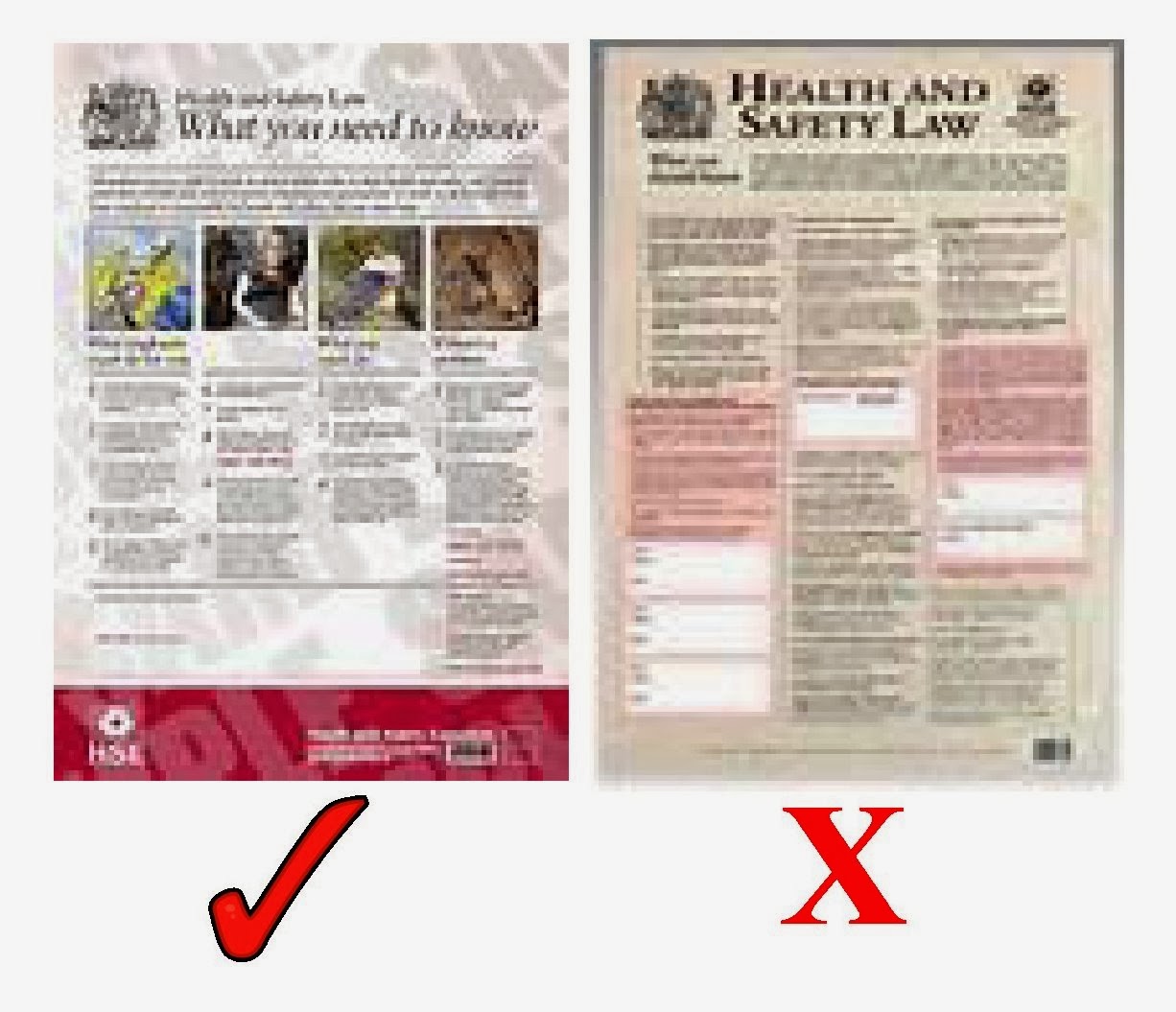
Health & Safety at Work Poster

Please don't forget that as from April 2014 all businesses must display the new version of the Health & Safety at Work poster.

We have noticed that there are still a lot of businesses with the old one on display, so to help you decide whether or not you have the right one, please look at the image below, the one on the left is the new one and the one on the right is the old one.

The new poster has been in existence for some time now and the HSE has always had the April 2014 date in mind for the final exchange, so don't expect a sympathetic ear if you're caught out with the wrong one.

Thursday, 8 March 2012

Guide to Safe Equipment at Work


Accidents happen in every walk of life and often, are down to lack of concentration or simple carelessness but accidents in the workplace can happen because equipment is not safe to use or a risk assessment hasn’t taken place.

Clearly, a worker should not use equipment if he or she thinks it isn’t safe but employers are bound by a duty of care which means they are ultimately responsible for making sure that both staff and visitors are not put at risk.

So employers must ensure that all equipment and machinery is safe for use. This means that it should be inspected regularly in case it has been damaged or misused.

Ensuring Safety in Your Business

Most obviously, you need to keep the workplace clean and safe for all and ensure that people are protected from falling from heights or being exposed to hazardous substances.
You should also check that all roads, walkways, floors and stairs are safe to use and not blocked by large pieces of equipment or piled up stock.

Although serious accidents can occur with large or specialised machinery, many injuries happen every year when employees are using basic every day equipment such as stepladders, hand saws or mechanical screwdrivers.

Inspections

So it’s extremely important to make sure that all equipment is inspected regularly. In most cases, a daily pre-check should be carried out. You can emphasise the importance to your workers through regular toolbox talks.

Show them some examples of accidents which have happened through every day equipment and make sure they know the importance of checking all equipment before they use it.
For example, before using a ladder they should check it visually for any broken or cracked rungs and ensure that the feet are solid.

They need to check that any locking devices on stepladders are working properly and should use any recommended safety equipment at heights, such as a harness.

Other equipment such as machinery should be visually checked and employees must know who is responsible for checking that any safety guards or switches are in good working order and that any moving parts, waste collectors and other gadgets have been oiled regularly.

If machinery has an exhaust system, this needs to be inspected on a regular basis.
Safety Aids

Research by the Health and Safety Executive has shown that experience is no substitute for safety guards or equipment.

It takes only a split second of concentration loss to lose a finger in cutting equipment but often, experienced workers have disabled safety features to make a machine easier to use.

It is easy to become complacent about small equipment such as wood saws or mechanical screwdrivers but they are capable of causing serious injury if not well maintained or used correctly.

Employers should make a list of all equipment in use and decide how and when it should be checked and who will note that an inspection has been undertaken. In the event of an accident, this will at least show that dangers have been taken seriously and that procedures are in place to keep employees safe.

Protective Equipment

Lots of every day equipment has the potential to cause injury unless workers have been given personal protective equipment (PPE) to reduce the chances of harm.

PPE equipment can vary from something as simple as clothing which provides protection against the weather to safety helmets, gloves, eye protection, safety footwear, noise reduction headphones or safety harnesses.

If PPE is needed for a job, it must be provided by the employer and they cannot charge employees for it.

It is important that employers provide the required PPE and ensure that it is fit for purpose. Check gloves for holes or damage, ensure that headphones are not broken and follow guidelines for checking harnesses.

Employees also have a responsibility towards their own safety and can refuse to undertake any job which they consider unsafe.

As an employee you can reduce the risk of accidents by reporting any faulty equipment or machinery as soon as possible. Make sure equipment that you are using is in good condition and well looked after. It should always be cleaned well and correctly stored after use.